
Rising Damp Treatment in Diss
Permanent chemical DPC injection to stop groundwater rising through your walls — guaranteed.
Rising Damp Treatment in Diss
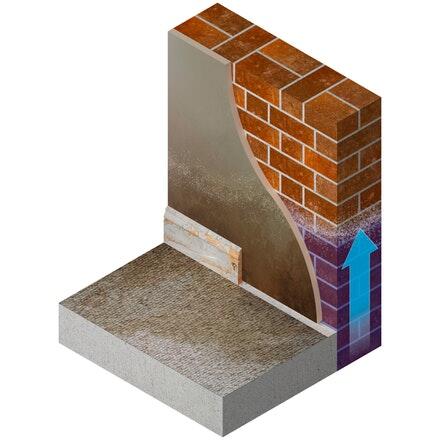
Rising damp occurs when groundwater travels upward through masonry by capillary action. The water carries dissolved salts from the soil into the wall structure; as it evaporates, it deposits these salts in the plaster and brick, causing the characteristic tide marks, crumbling plaster, salt efflorescence, and musty smell that homeowners recognise. Left untreated, rising damp progressively destroys plaster, wallcoverings, and skirting boards, and can weaken the mortar joints in brickwork over time.
In older properties — particularly those built before 1919 — rising damp is most often caused by the absence of a damp proof course or the failure of an original slate, bitumen, or early chemical DPC. In some cases, the DPC is still present but has been bypassed by raised external ground levels, which allow soil and moisture to contact the wall above the course. Correctly diagnosing which situation applies is essential, as the treatment differs significantly.
Signs to Look For in Your Diss Property
- →Horizontal tide mark on internal walls, typically no higher than 1–1.2 metres from floor level
- →White powdery deposits (salt efflorescence) on brick or plaster surfaces
- →Plaster that is soft, blown, crumbling, or separating from the wall at low level
- →Skirting boards that are rotting, stained, or lifting away from the wall
- →Yellowish-brown staining on walls and skirting boards at low level
- →A persistent musty smell in ground floor rooms, particularly in winter
Why Diss Properties Are Particularly Affected
Many of Diss's older properties in and around the town centre were built without damp proof courses. The heavier clay soils around the Mere and throughout the Waveney Valley hold moisture effectively, keeping groundwater levels elevated and creating ideal conditions for rising damp in the lower sections of walls.
Diss sits on the Norfolk-Suffolk border in the Waveney Valley, on moderately heavy clay soils. The Mere — the natural lake at the centre of the town — contributes to elevated local groundwater in the surrounding streets. Older properties near the water are particularly susceptible to high sub-floor moisture levels.
How We Treat Rising Damp Treatment in Diss
Inject a silicone-based damp proof cream into a continuous horizontal course of drill holes at low level, creating a new chemical DPC within the masonry
Remove all salt-contaminated plaster from affected walls — redecorating without this step will not produce a lasting result
Apply a salt-retardant sand and cement rendering system, or a specialist two-coat sand and cement system with salt-inhibiting additives
Reduce external ground levels where necessary to restore the DPC to its correct position relative to the external ground
Issue a long-term guarantee covering the treatment against rising damp recurrence
Areas Covered in Norfolk
We provide rising damp treatment throughout Diss (IP21, IP22) and the surrounding areas including Scole, Dickleburgh, Harleston, Eye, Bressingham, Burston, Wortham, Long Stratton.
Our local inspection team can usually attend within 48 hours. Call 01473 561 031 or use the form to book.
Common Questions About Rising Damp Treatment in Diss
Our Diss Guarantee
All our rising damp treatment work in Diss comes with a long-term written guarantee. Our guarantees are accepted by the majority of UK mortgage lenders and are transferable to new owners on sale of the property.
Related Services in Diss
Free Diss Inspection
Request an Inspection
Leave us your details and we'll be in touch